Soft Pastel Materials for Beginners: A Quick-Start Guide
Suggested materials
Starting with soft pastel does not mean buying a huge collection of art materials. These are the soft pastel materials for beginners that I recommend for my online workshops—but please don’t feel that you need to own everything before you begin.
Use what you already have wherever possible. Each of my workshops also includes a more specific materials list, reference image and colour suggestions, so you can check what you need before buying anything new.
If you’re eager to begin, this is all you really need
The quick-start list
- A small set of soft pastels – I like Unison Colour starter set of 8 half sticks
- A suitable pastel paper or card – I like Pastelmat for details and Uart400 for expressive work.
- A firm board to support your paper
- Masking tape or framers’ tape
- A damp cloth or kitchen roll
- The reference image and materials information supplied with your workshop
Pastel pencils, brushes, hard pastels, liquid and fixative can all be useful, but they are additions rather than essentials. You can build your collection gradually as you discover what you enjoy using. Read on for some of my favourites.
Choosing your first soft pastels
If you already own some soft pastels, begin with those. Different brands vary in softness, strength of colour and the amount of pigment they contain, but experimenting with what you have is part of learning.
If you are standing in an art shop wondering where to begin, there are two sensible approaches.
A good starting point
An affordable half-stick set will give you a useful range of colours without requiring a large investment. An Inscribe 64 half-stick set is one option, although these pastels will feel firmer and contain less pigment than a professional-quality brand.
You could combine an affordable starter set with one or two softer, higher-quality individual pastels. This gives you an opportunity to feel the difference without committing to an expensive collection.
White and sky blue are particularly useful colours for many subjects, so these would be good individual colours to try first.
If you would like to invest
It is often better to buy a smaller selection of good-quality pastels than an enormous collection of cheaper ones.
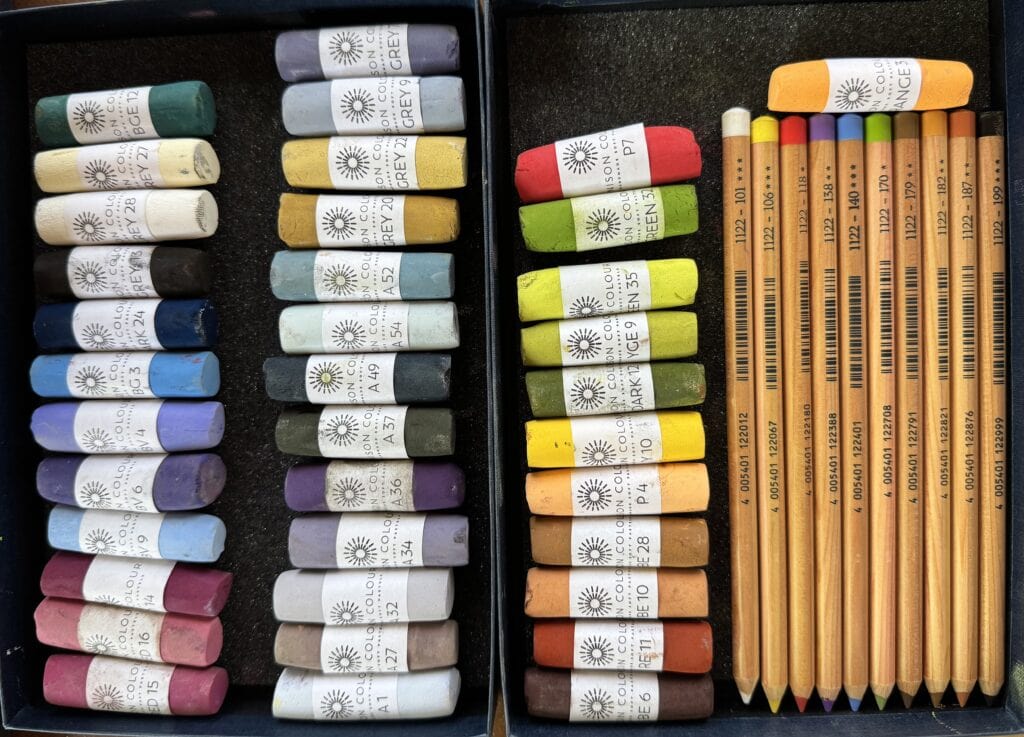
I am a Unison Colour Associate Artist and use Unison Colour soft pastels in my own paintings and workshops. They are handmade, beautifully soft and contain plenty of pigment. This makes them lovely to use dry and particularly responsive when mixed with liquid.
A starter or half-stick set will give you a useful foundation. You can then add individual colours as you discover which ones you reach for most frequently.
White is especially useful. In the Unison Colour range, white may be labelled Light 1 or Grey 28. I would also add a good sky blue and one or two rich dark colours when you are ready.
You don’t need to match every colour I use exactly. Look at the colours you already own and choose the nearest equivalent. Part of the fun is discovering how your own collection works.
Choosing your pastel paper or card
The surface you work on can make an enormous difference to your experience of soft pastel.
Specialist pastel papers and cards have a textured or gritted surface—often described as having a “tooth”. This catches the pastel and allows you to build several layers of colour.
When someone comes to one of my in-person classes for a taster session, I give them a suitable piece of pastel card as part of their day. I know that a good surface helps a beginner enjoy the process and achieve a result they feel pleased with.
However, if you only have watercolour paper or cartridge paper, please don’t let that stop you. You may find it more difficult to build lots of layers, but the important thing is to begin.
Understand the pastel painting process
These specialist pastel surfaces are particularly useful when using water or alcohol to create a loose, paint-like underpainting.
You can read more about this technique in my Painting with Pastel – Introduction.
For dry pastel and a light wash
Clairefontaine Pastelmat is a popular and forgiving surface. It holds plenty of pastel and can take a light wash, although it isn’t my first choice for the wetter underpainting technique I often demonstrate.
Sennelier La Carte Pastel Card is lovely for dry pastel, but it must not be wetted. Liquid can damage its surface. There is now a version that will allow liquid. Double check ahead of using.
For Painting with pastel and liquid
If you want to liquefy your pastels, you need a robust surface that will retain its texture after liquid has been applied.
My preferred surfaces include:
- UART 400
- Art Spectrum Colourfix Original
- Canson Mi-Teintes Touch
When buying Mi-Teintes, check that you are choosing the textured Touch surface rather than ordinary Mi-Teintes paper.

A practical studio tip
I always keep kitchen roll and a lightly dampened cloth nearby when I work.
The damp cloth is useful for cleaning my hands and working surface without sending pastel dust into the air. Some pastel papers do not like water, so remember to dry your hands before touching your artwork.
An old sheet underneath your chair or easel can protect the carpet and make cleaning easier. The are simple habits but they make working with pastels much more comfortable.
Choosing a paper colour
There isn’t one correct paper colour. Choose something that works with the subject and the atmosphere you would like to create.
A darker surface can help produce a dramatic or moody painting. A lighter surface may suit a sunny or more delicate scene.
I often look for a colour that already appears somewhere within my reference image. For seascapes, I enjoy working on warm blues, greys, creams and sandy colours. This means that small areas of the surface can remain visible and become part of the finished painting.
Don’t worry too much about making the perfect choice. The same subject painted on two different colours can produce two very different—and equally interesting—results.
Using liquid with soft pastel
Liquefying soft pastel is one of my favourite ways of working.
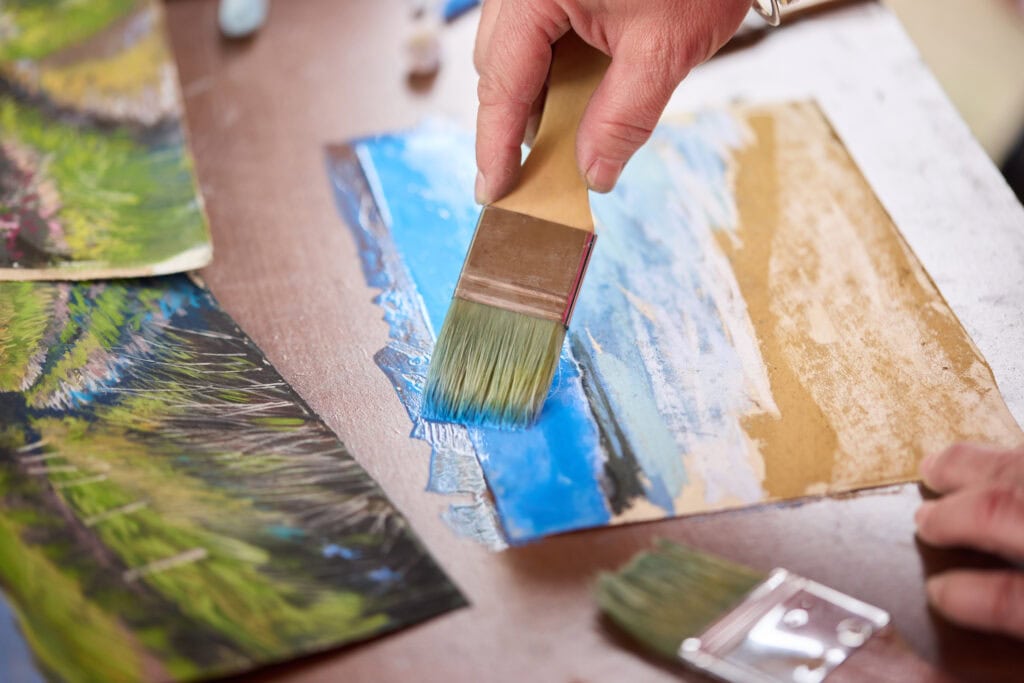
You can use water, but I often use alcohol, such as vodka, because it evaporates more quickly. Some pastels respond beautifully and turn into a rich, paint-like paste. Other brands and colours may behave differently, so try yours on a small offcut of paper first.
Liquid can be applied with a brush. I sometimes use a fine-mist spray bottle, but only a small amount is needed. The aim is to activate the pigment rather than saturate the surface.
If you use alcohol, work in a well-ventilated space, use it sparingly and keep it away from flames or other sources of heat.
You could also use watercolour or ink to create an underpainting before adding dry pastel. There are lots of ways to experiment, and there is no single correct method.
Do I need pastel pencils?
Pastel pencils are optional, but I think they are enormously useful.
They allow you to create finer marks and small details. I also use them to soften edges and blend areas of pastel without using my fingers.
You certainly don’t need to buy a large tin. I think it is much better to begin with a small selection of useful colours and add to them gradually. This means you can spend your money on the pencils you are most likely to use.
These Faber-Castell Pitt Pastel Pencils provide a useful starting selection:
- 101 White
- 106 Light Chrome Yellow
- 118 Scarlet Red
- 138 Violet
- 140 Light Ultramarine
- 170 May Green
- 179 Bistre
- 182 Brown Ochre
- 187 Burnt Ochre
- 199 Black
You do not have to buy all ten at once. White, a dark colour, blue, green and a warm brown would give you a very practical first group.
When you book one of my workshops, the materials information will suggest any specific pencils that I use for that particular subject.
A good pencil sharpener is helpful. Some artists carefully use a craft knife and a little sandpaper to create a finer point, but always cut away from yourself and take care.
Are hard pastels useful?
Hard pastel sticks, such as Conté pastels, can be useful for drawing, creating an underpainting and adding finer marks.
They are an optional addition rather than something you need to buy immediately. If you already own some, bring them into your experiments and see how they work alongside your softer pastels.
A firm board and masking tape
Attach your paper to a firm board while you work. I often use the backing board from an old picture frame, but you can also buy a suitable board from an art or hardware shop.
A board of approximately A3 size is useful for many workshops.
I usually secure only the corners of my paper. Other artists prefer to tape all four sides, which creates a clean border around the finished painting. Both approaches are fine.
Use masking tape or framers’ tape that can be removed without damaging the surface. If you are unsure about a new tape, test it on an offcut first.
The board also makes it easier to store or transport your painting safely between sessions.
Brushes
If you want to use liquid with your pastels, a brush is helpful.
I like flat, lightly bristled brushes that allow me to move the liquefied pastel around the surface. If you are buying two, choose one smaller and one larger brush. If you only want one, a medium-sized flat brush is a useful starting point.
You don’t need to use your most precious watercolour brush. Pastel pigment can be quite demanding on brushes, so I keep the ones I use with pastel separate from my other painting brushes.
Where can I buy soft pastel materials?
Specialist art shops and established online suppliers sell individual pastel sticks, pencils and pastel surfaces.
Buying individual colours is useful because you can replace only the ones you use most frequently. It also allows you to grow your collection gradually rather than buying another complete set.
Unison Colour are my pastel of choice and I am a Unison Colour Associate Artist. Unison Colour asked me visit Jackson’s Art HQ and talk about their pastels. It was lovely to see Jacksons Art studio and I enjoyed chatting to the team about how I use them in my own work and teaching. You can watch the video here.
Jackson’s Art now has a dedicated ‘Nina Squire’ page featuring a selection of materials connected with my workshops. You certainly don’t need to purchase everything shown, but it may help you identify some of the pastels, papers and tools mentioned in this guide.
View Nina Squire’s artist workshop page at Jackson’s Art
Always check the complete product name when ordering specialist paper. Several manufacturers produce ordinary drawing papers and textured pastel surfaces with very similar names.
Before making a large purchase, check the materials information for your chosen workshop. You may already own perfectly suitable alternatives, you don’t need the same brand as me, just a good quality alternative.
Should I use fixative?
Fixing soft pastel is a much-debated subject. Some artists use fixative and others avoid it completely.
Fixative can alter or darken pastel colours, and even a fixed pastel painting remains delicate. If you decide to use it, choose a product intended for soft pastel, follow the manufacturer’s instructions and test it on a small sample first.
Some artists apply fixative between layers, but beginners don’t need to worry about this immediately. Careful storage is usually more important.
I wouldn’t recommend relying on hairspray for a painting that you would like to preserve. It isn’t designed as an archival art material and may discolour over time.
Storing your pastel paintings
Soft pastel remains vulnerable to rubbing and smudging, so finished and unfinished work needs to be stored carefully.
Leave the painting attached to its board and cover it with glassine paper. Clean, flat greaseproof paper can provide temporary protection if you don’t have glassine.
Secure the protective sheet so it cannot move across the pastel surface, and avoid resting anything directly against the artwork.
When you are ready to frame a favourite painting, a professional framer can advise you about suitable mounting, spacing and glass.

Using soft pastel safely
Soft pastels create dust, so sensible studio habits are important. Good quality pastel on good quality surfaces produce very little dust.
Follow the safety information supplied by the manufacturer and consider these simple precautions:
- Keep food and drink away from your working area. I know how easily a cup of tea can migrate underneath an easel, but pastel dust is not a welcome addition!
- Wash your hands after using pastels.
- Avoid blowing dust from the surface of your painting.
- Gently tap loose dust downwards rather than sweeping it into the air.
- Clean your desk and nearby surfaces with a damp cloth.
- Work in a well-ventilated space.
- If you are sensitive to dust or concerned about exposure, take appropriate precautions.
- Keep your materials and working area away from children and pets.
- Use an easel or prop up your board if working completely flat causes discomfort.
You can also read the manufacturer’s Unison Colour safety information.
What if I am nervous about doing it wrong?
If you ask ten artists how they use soft pastel, you may receive ten different answers.
We all develop our favourite surfaces, colours, tools and techniques through experience. There is no single correct collection of materials and no need to buy everything before you begin.
Please don’t wait for the perfect paper, the perfect colours or the perfect moment. Start with what you have, experiment and add materials gradually as your confidence grows.
Some things won’t work quite as you expected, but that is how you discover what your pastels can do. There are no wasted experiments—they all become part of your experience as an artist.
The most important thing is to get pastelling. You’ll love it!
happy pastelling
